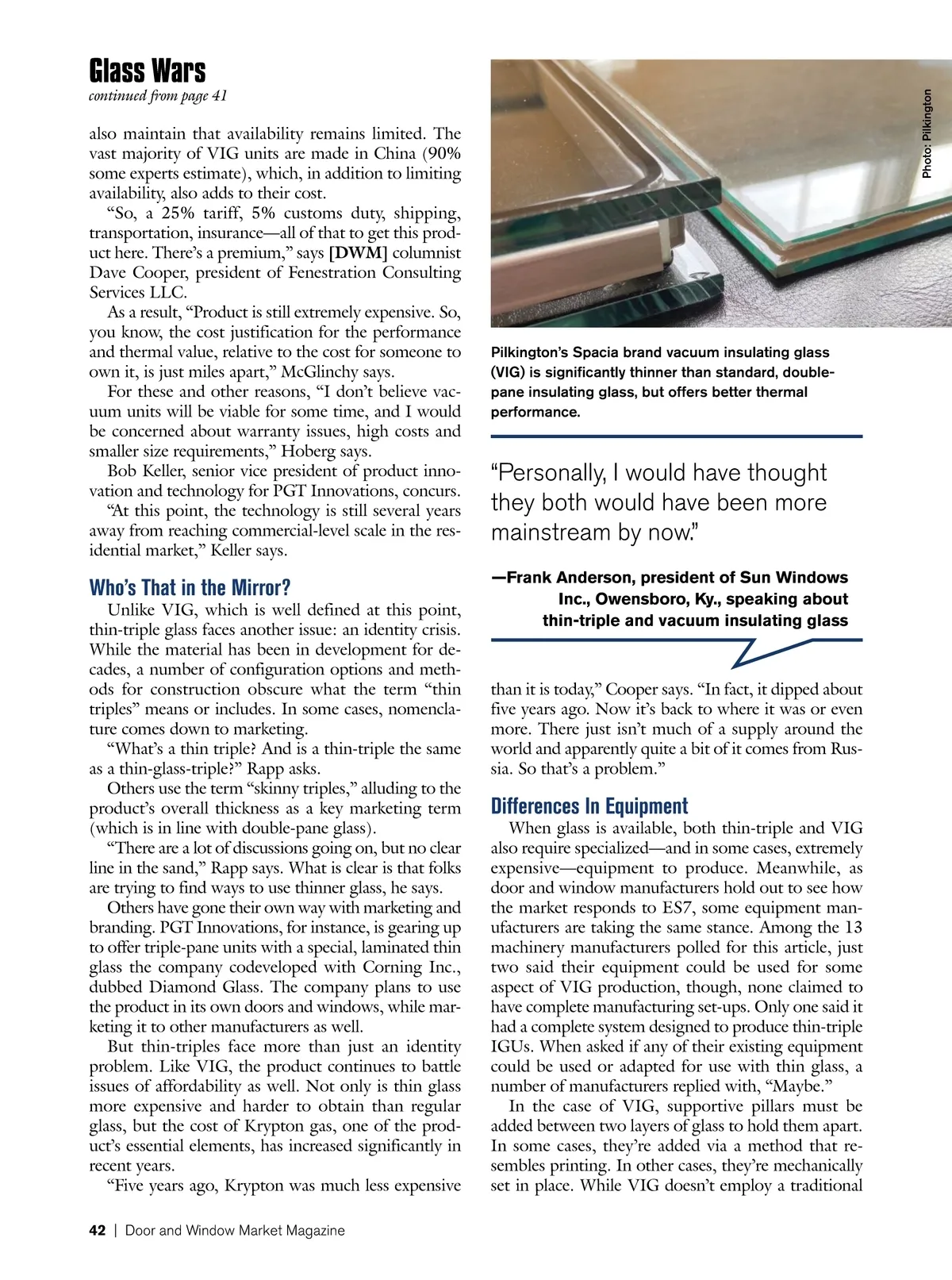
also maintain that availability remains limited. The vast majority of VIG units are made in China (90% some experts estimate), which, in addition to limiting availability, also adds to their cost. “So, a 25% tariff, 5% customs duty, shipping, transportation, insurance—all of that to get this prod-uct here. There’s a premium,” says [DWM] columnist Dave Cooper, president of Fenestration Consulting Services LLC. As a result, “Product is still extremely expensive. So, you know, the cost justification for the performance and thermal value, relative to the cost for someone to own it, is just miles apart,” McGlinchy says. For these and other reasons, “I don’t believe vac-uum units will be viable for some time, and I would be concerned about warranty issues, high costs and smaller size requirements,” Hoberg says. Bob Keller, senior vice president of product inno-vation and technology for PGT Innovations, concurs. “At this point, the technology is still several years away from reaching commercial-level scale in the res-idential market,” Keller says. Unlike VIG, which is well defined at this point, thin-triple glass faces another issue: an identity crisis. While the material has been in development for de-cades, a number of configuration options and meth-ods for construction obscure what the term “thin triples” means or includes. In some cases, nomencla-ture comes down to marketing. “What’s a thin triple? And is a thin-triple the same as a thin-glass-triple?” Rapp asks. Others use the term “skinny triples,” alluding to the product’s overall thickness as a key marketing term (which is in line with double-pane glass). “There are a lot of discussions going on, but no clear line in the sand,” Rapp says. What is clear is that folks are trying to find ways to use thinner glass, he says. Others have gone their own way with marketing and branding. PGT Innovations, for instance, is gearing up to offer triple-pane units with a special, laminated thin glass the company codeveloped with Corning Inc., dubbed Diamond Glass. The company plans to use the product in its own doors and windows, while mar-keting it to other manufacturers as well. But thin-triples face more than just an identity problem. Like VIG, the product continues to battle issues of affordability as well. Not only is thin glass more expensive and harder to obtain than regular glass, but the cost of Krypton gas, one of the prod-uct’s essential elements, has increased significantly in recent years. “Five years ago, Krypton was much less expensive 42 | Door and Window Market Magazine Pilkington’s Spacia brand vacuum insulating glass (VIG) is significantly thinner than standard, double-pane insulating glass, but offers better thermal performance. “Personally, I would have thought they both would have been more mainstream by now.” —Frank Anderson, president of Sun Windows Inc., Owensboro, Ky., speaking about thin-triple and vacuum insulating glass Who’s That in the Mirror? than it is today,” Cooper says. “In fact, it dipped about five years ago. Now it’s back to where it was or even more. There just isn’t much of a supply around the world and apparently quite a bit of it comes from Rus-sia. So that’s a problem.” Differences In Equipment When glass is available, both thin-triple and VIG also require specialized—and in some cases, extremely expensive—equipment to produce. Meanwhile, as door and window manufacturers hold out to see how the market responds to ES7, some equipment man-ufacturers are taking the same stance. Among the 13 machinery manufacturers polled for this article, just two said their equipment could be used for some aspect of VIG production, though, none claimed to have complete manufacturing set-ups. Only one said it had a complete system designed to produce thin-triple IGUs. When asked if any of their existing equipment could be used or adapted for use with thin glass, a number of manufacturers replied with, “Maybe.” In the case of VIG, supportive pillars must be added between two layers of glass to hold them apart. In some cases, they’re added via a method that re-sembles printing. In other cases, they’re mechanically set in place. While VIG doesn’t employ a traditional Photo: Pilkington Glass Wars continued from page 41
Door & Window Market Sept/Oct 2023: Page 42