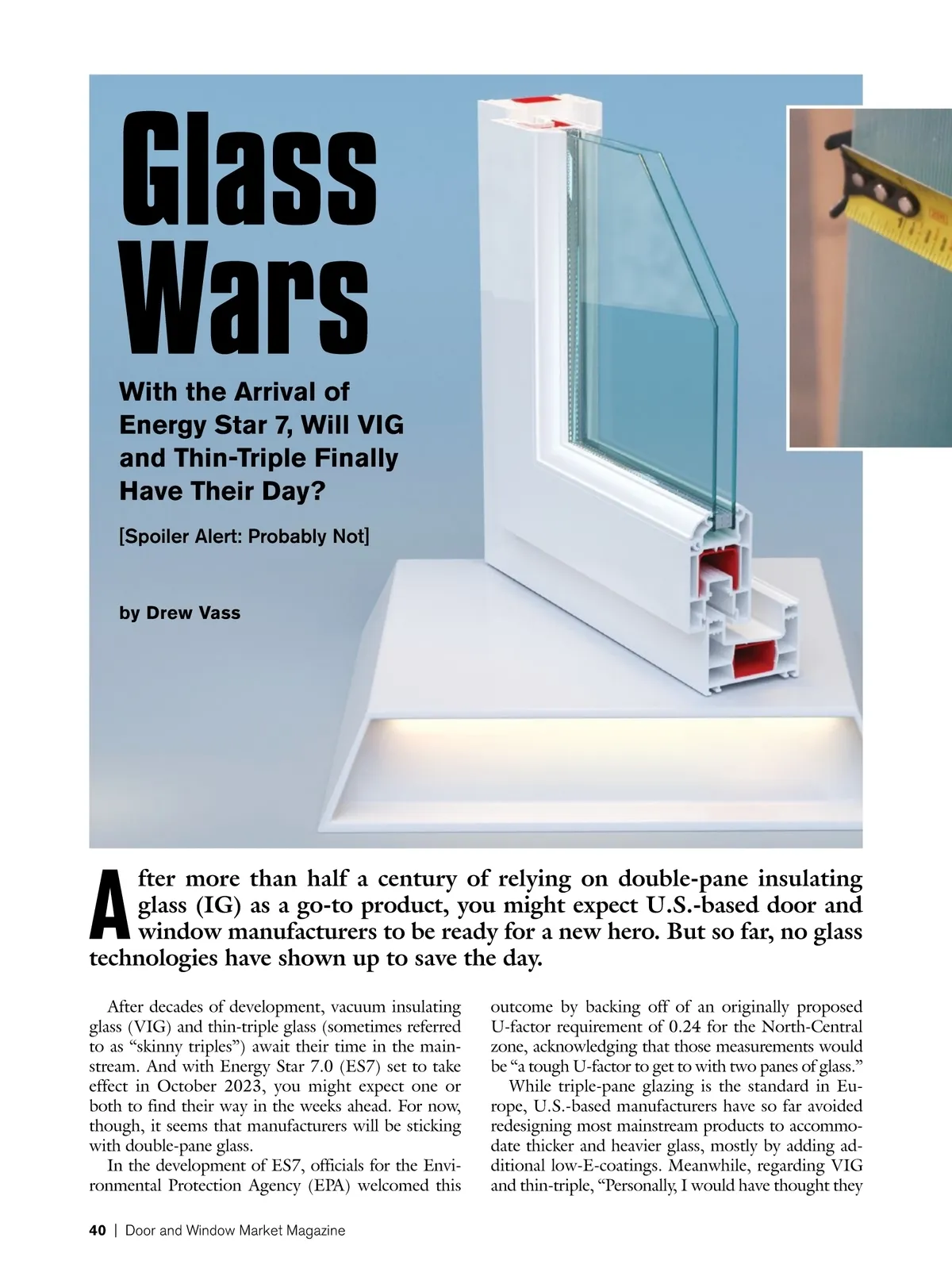
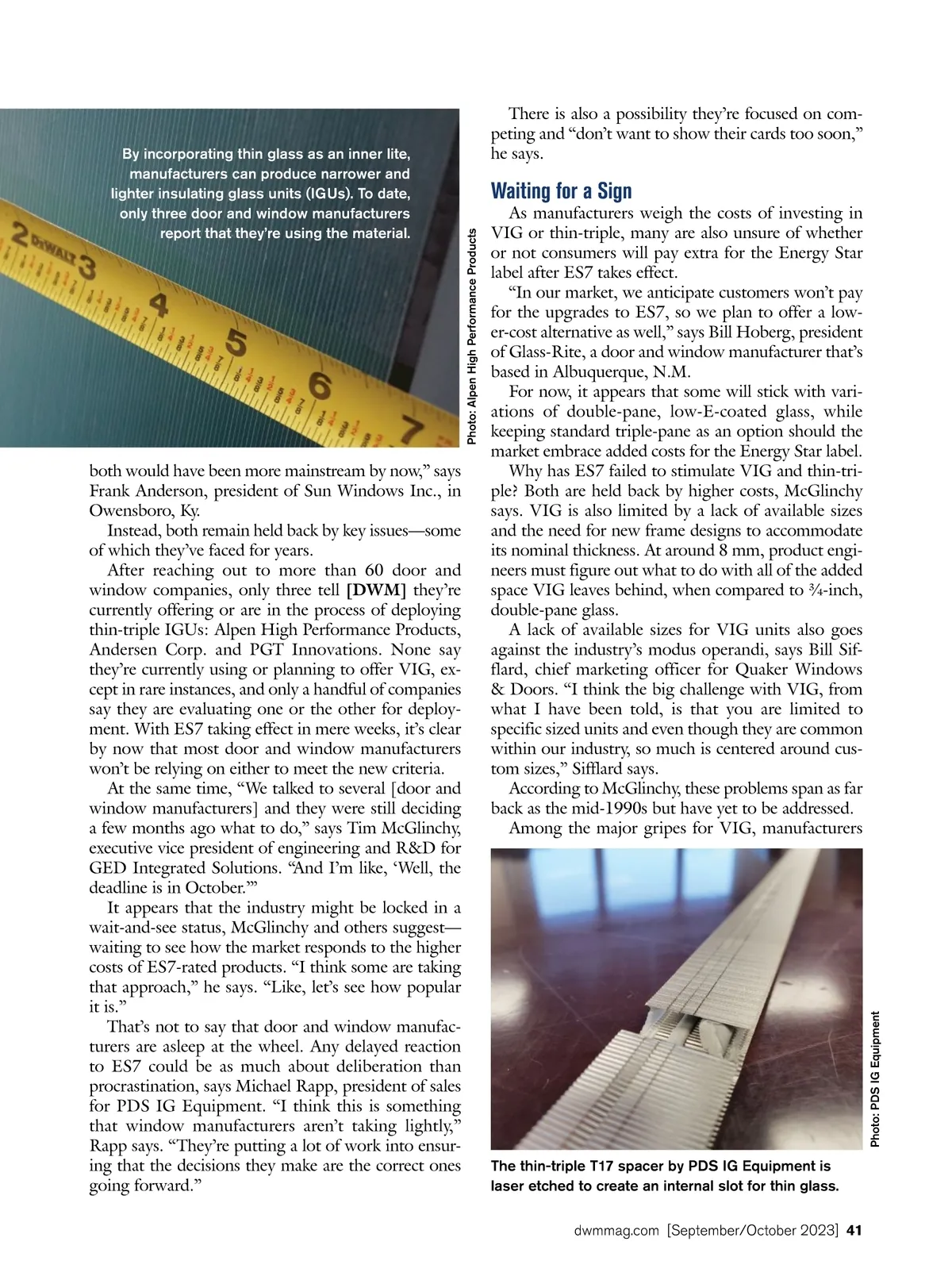
both would have been more mainstream by now,” says Frank Anderson, president of Sun Windows Inc., in Owensboro, Ky. Instead, both remain held back by key issues—some of which they’ve faced for years. After reaching out to more than 60 door and window companies, only three tell [DWM] they’re currently offering or are in the process of deploying thin-triple IGUs: Alpen High Performance Products, Andersen Corp. and PGT Innovations. None say they’re currently using or planning to offer VIG, ex-cept in rare instances, and only a handful of companies say they are evaluating one or the other for deploy-ment. With ES7 taking effect in mere weeks, it’s clear by now that most door and window manufacturers won’t be relying on either to meet the new criteria. At the same time, “We talked to several [door and window manufacturers] and they were still deciding a few months ago what to do,” says Tim McGlinchy, executive vice president of engineering and R&D for GED Integrated Solutions. “And I’m like, ‘Well, the deadline is in October.’” It appears that the industry might be locked in a wait-and-see status, McGlinchy and others suggest— waiting to see how the market responds to the higher costs of ES7-rated products. “I think some are taking that approach,” he says. “Like, let’s see how popular it is.” That’s not to say that door and window manufac-turers are asleep at the wheel. Any delayed reaction to ES7 could be as much about deliberation than procrastination, says Michael Rapp, president of sales for PDS IG Equipment. “I think this is something that window manufacturers aren’t taking lightly,” Rapp says. “They’re putting a lot of work into ensur-ing that the decisions they make are the correct ones going forward.” Photo: Alpen High Performance Products By incorporating thin glass as an inner lite, manufacturers can produce narrower and lighter insulating glass units (IGUs). To date, only three door and window manufacturers report that they’re using the material. There is also a possibility they’re focused on com-peting and “don’t want to show their cards too soon,” he says. Waiting for a Sign As manufacturers weigh the costs of investing in VIG or thin-triple, many are also unsure of whether or not consumers will pay extra for the Energy Star label after ES7 takes effect. “In our market, we anticipate customers won’t pay for the upgrades to ES7, so we plan to offer a low-er-cost alternative as well,” says Bill Hoberg, president of Glass-Rite, a door and window manufacturer that’s based in Albuquerque, N.M. For now, it appears that some will stick with vari-ations of double-pane, low-E-coated glass, while keeping standard triple-pane as an option should the market embrace added costs for the Energy Star label. Why has ES7 failed to stimulate VIG and thin-tri-ple? Both are held back by higher costs, McGlinchy says. VIG is also limited by a lack of available sizes and the need for new frame designs to accommodate its nominal thickness. At around 8 mm, product engi-neers must figure out what to do with all of the added space VIG leaves behind, when compared to ¾-inch, double-pane glass. A lack of available sizes for VIG units also goes against the industry’s modus operandi, says Bill Sif-flard, chief marketing officer for Quaker Windows & Doors. “I think the big challenge with VIG, from what I have been told, is that you are limited to specific sized units and even though they are common within our industry, so much is centered around cus-tom sizes,” Sifflard says. According to McGlinchy, these problems span as far back as the mid-1990s but have yet to be addressed. Among the major gripes for VIG, manufacturers The thin-triple T17 spacer by PDS IG Equipment is laser etched to create an internal slot for thin glass. dwmmag.com [September/October 2023] 41 Photo: PDS IG Equipment
Door & Window Market Sept/Oct 2023: Page 41