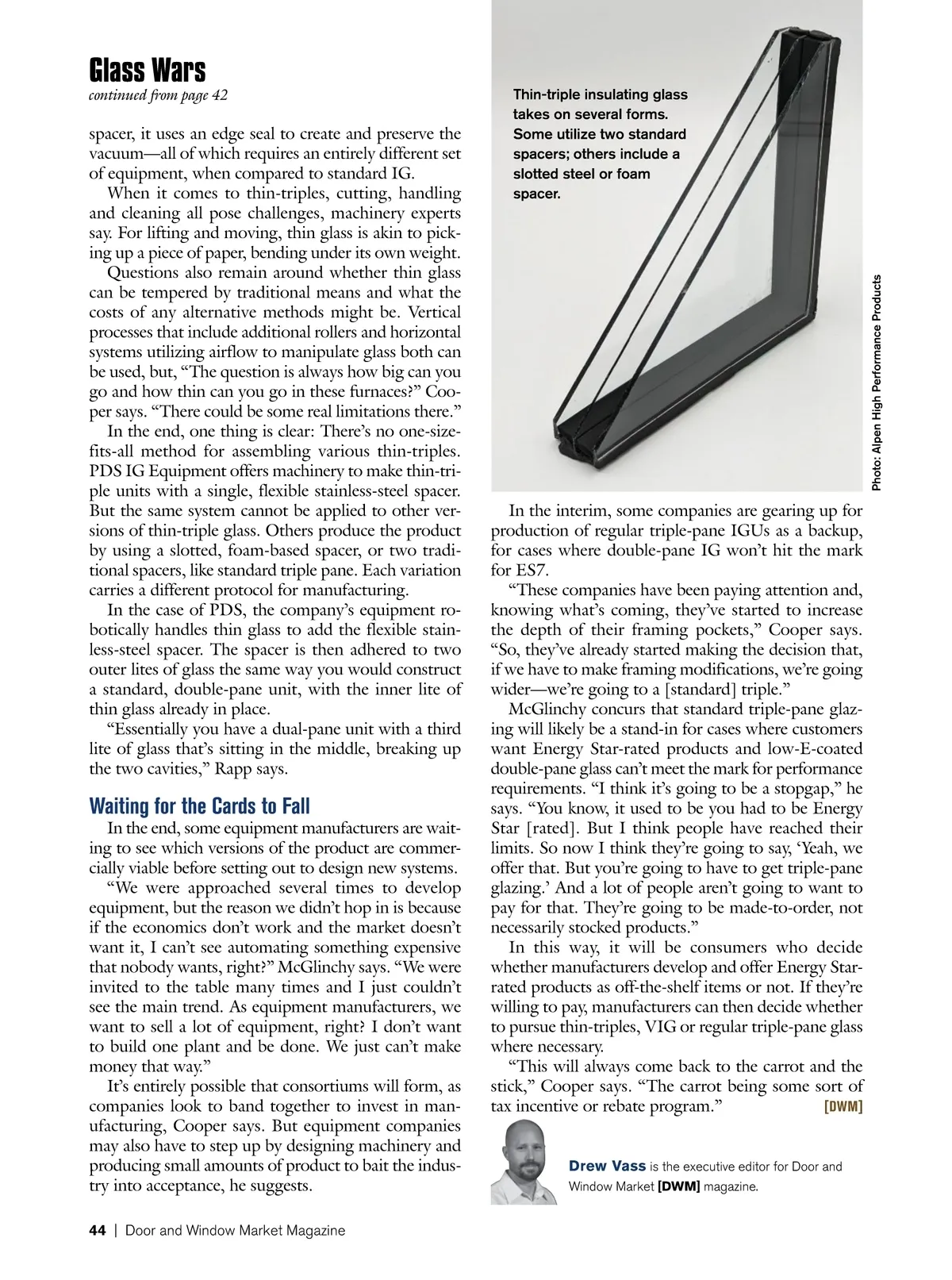
Glass Wars continued from page 42 spacer, it uses an edge seal to create and preserve the vacuum—all of which requires an entirely different set of equipment, when compared to standard IG. When it comes to thin-triples, cutting, handling and cleaning all pose challenges, machinery experts say. For lifting and moving, thin glass is akin to pick-ing up a piece of paper, bending under its own weight. Questions also remain around whether thin glass can be tempered by traditional means and what the costs of any alternative methods might be. Vertical processes that include additional rollers and horizontal systems utilizing airflow to manipulate glass both can be used, but, “The question is always how big can you go and how thin can you go in these furnaces?” Coo-per says. “There could be some real limitations there.” In the end, one thing is clear: There’s no one-size-fits-all method for assembling various thin-triples. PDS IG Equipment offers machinery to make thin-tri-ple units with a single, flexible stainless-steel spacer. But the same system cannot be applied to other ver-sions of thin-triple glass. Others produce the product by using a slotted, foam-based spacer, or two tradi-tional spacers, like standard triple pane. Each variation carries a different protocol for manufacturing. In the case of PDS, the company’s equipment ro-botically handles thin glass to add the flexible stain-less-steel spacer. The spacer is then adhered to two outer lites of glass the same way you would construct a standard, double-pane unit, with the inner lite of thin glass already in place. “Essentially you have a dual-pane unit with a third lite of glass that’s sitting in the middle, breaking up the two cavities,” Rapp says. In the end, some equipment manufacturers are wait-ing to see which versions of the product are commer-cially viable before setting out to design new systems. “We were approached several times to develop equipment, but the reason we didn’t hop in is because if the economics don’t work and the market doesn’t want it, I can’t see automating something expensive that nobody wants, right?” McGlinchy says. “We were invited to the table many times and I just couldn’t see the main trend. As equipment manufacturers, we want to sell a lot of equipment, right? I don’t want to build one plant and be done. We just can’t make money that way.” It’s entirely possible that consortiums will form, as companies look to band together to invest in man-ufacturing, Cooper says. But equipment companies may also have to step up by designing machinery and producing small amounts of product to bait the indus-try into acceptance, he suggests. 44 | Door and Window Market Magazine Thin-triple insulating glass takes on several forms. Some utilize two standard spacers; others include a slotted steel or foam spacer. Waiting for the Cards to Fall In the interim, some companies are gearing up for production of regular triple-pane IGUs as a backup, for cases where double-pane IG won’t hit the mark for ES7. “These companies have been paying attention and, knowing what’s coming, they’ve started to increase the depth of their framing pockets,” Cooper says. “So, they’ve already started making the decision that, if we have to make framing modifications, we’re going wider—we’re going to a [standard] triple.” McGlinchy concurs that standard triple-pane glaz-ing will likely be a stand-in for cases where customers want Energy Star-rated products and low-E-coated double-pane glass can’t meet the mark for performance requirements. “I think it’s going to be a stopgap,” he says. “You know, it used to be you had to be Energy Star [rated]. But I think people have reached their limits. So now I think they’re going to say, ‘Yeah, we offer that. But you’re going to have to get triple-pane glazing.’ And a lot of people aren’t going to want to pay for that. They’re going to be made-to-order, not necessarily stocked products.” In this way, it will be consumers who decide whether manufacturers develop and offer Energy Star-rated products as off-the-shelf items or not. If they’re willing to pay, manufacturers can then decide whether to pursue thin-triples, VIG or regular triple-pane glass where necessary. “This will always come back to the carrot and the stick,” Cooper says. “The carrot being some sort of tax incentive or rebate program.” [DWM] Drew Vass is the executive editor for Door and Window Market [DWM] magazine. Photo: Alpen High Performance Products
Door & Window Market Sept/Oct 2023: Page 44